
6 Ways to Rethink Your SEO Strategy for 2026: Your Guide to AI-First Visibility

Introduction
By 2026, search won’t look like it does today. Gartner predicts traditional search volume will drop by 25% as users shift to AI chatbots and virtual agents for answers. This isn’t just another algorithm update. It’s a turning point. We’re entering the era of AI SEO (AI-First Visibility) , where your brand’s role isn’t just to rank, but to be recognized, referenced, and trusted by AI systems like ChatGPT, Perplexity, and Google’s Search Generative Experience.
Let’s reframe the opportunity. This is your chance to become the go-to source in your space, not just on Google, but wherever your audience turns for instant, intelligent answers.
TL;DR: The Mindset Shift You Need
For AI-First Visibility in 2026, stop chasing keywords. Start designing content that earns AI trust and gets cited. Think answer-first, entity-driven, deeply human, and technically sound. It’s not just about search engines anymore. It’s about showing up as a reliable source in an AI-powered world.
5 Moves for AI-First Visibility
-
Lead with Entities, Not Just Keywords
Build depth across interconnected topics. Think of your brand as a node in a knowledge map, not just a set of tags. -
E-E-A-T Is Your Differentiator
Show your work. Lean into real experience, verified expertise, and transparent processes to stand out from AI-generated noise. -
Optimize for Clarity, Not Just Clicks
Structure your content for AI consumption. Clear answers, skimmable summaries, and question-based headers are your new best friends. -
Build Authority Beyond Your Site
Be present where AI looks. Quora, Reddit, LinkedIn. The more you’re cited, the more you’re seen as a credible source. -
Tighten Up Technical SEO
If AI can’t crawl it, it won’t count it. Schema, Core Web Vitals, and emerging tools like llms.txt ensure your content is machine-ready.
The 6 Core Pillars of AI SEO Strategy for 2026
These aren’t isolated tactics. They work together as a system. Visibility depends on being recognized as a trusted entity, proving real-world authority, and building an infrastructure that AI can parse confidently.
1. Answer-First Content for AI Overviews
Start every piece with a question your audience actually asks. Lead with the answer. Design for snippets. Embrace tools like FAQ and TL;DR sections. Structure it so machines can extract it, and humans can trust it.
Try this:
-
Turn headers into questions
-
Open sections with direct answers
-
Use bullet lists, summaries, and structured markup
-
Source questions from Google’s “People Also Ask”
2. Deepen Topical Authority to Become an Entity
Search engines now identify concepts, not just keywords. Use the hub-and-spoke model to organize content around primary topics and their related branches. The goal is to be the authority in your niche by showing depth, consistency, and interconnection.
3. Elevate E-E-A-T with Real Experience
Generic AI content is flooding the web. Your moat is human proof. Use author bios, case studies, original research, and behind-the-scenes visuals to prove you’ve lived what you teach.
Embed trust by:
-
Publishing bios with credentials and third-party links
-
Featuring testimonials tied to local context
-
Sharing first-hand data or results
-
Making your editorial process public
4. Embrace Generative Engine Optimization (G-EO)
Think beyond your site. G-EO is about being the name AI recommends because you’ve earned digital street cred across high-trust platforms. Share your voice where AI listens: Quora, Reddit, LinkedIn, credible blogs.
Pro tip:
AI learns from where people learn. Be cited, not just crawled.
5. Make Your Tech Stack AI-Friendly
Your content must be easy to find, read, and interpret by both humans and machines.
Prioritize:
-
Schema markup to clarify who you are and what you do
-
Web vitals that support speed, stability, and usability
-
Early adoption of tools like llms.txt to guide AI to your best work
6. Prepare for Agentic AI and First-Party Data
We’re heading into a world of AI agents making decisions on users’ behalf. Your content must support decision-making. At the same time, with third-party cookies fading out, earning consent for first-party data becomes your most strategic asset.
What this means:
-
Structure product or service data for AI to act on
-
Use trust-building UX to collect first-party data
-
Stay transparent. Privacy is part of your brand story now
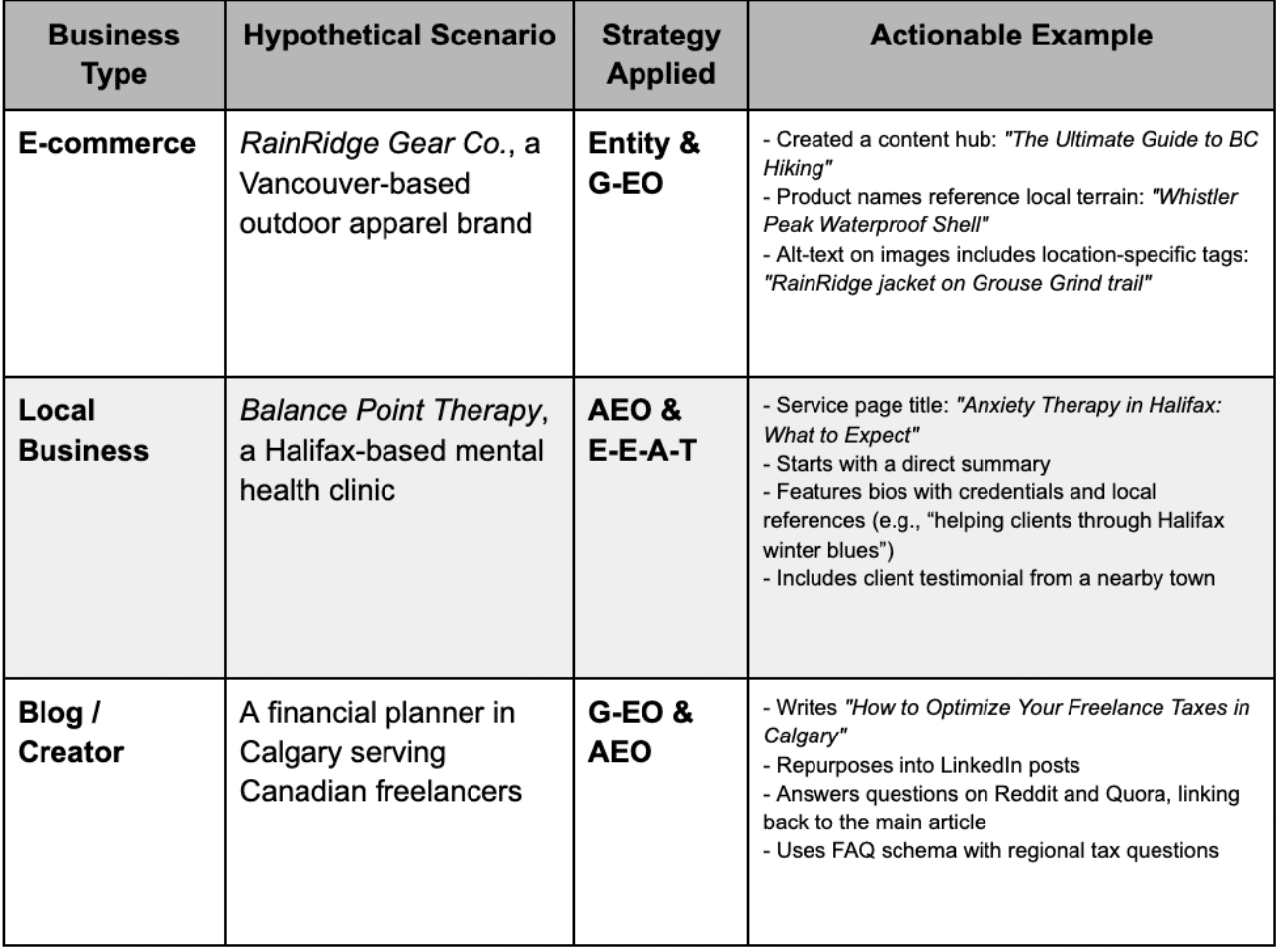
How AI SEO Strategy Could Apply to Your Business
Conclusion
The Real Shift: From Rankings to Relationships
This isn’t just about visibility. It’s about trust. AI-powered search is teaching us to be better marketers. It’s pushing us toward depth, clarity, and proof. The brands that thrive will be the ones that feel more like guides than billboards.
Ready to be the one AI recommends?